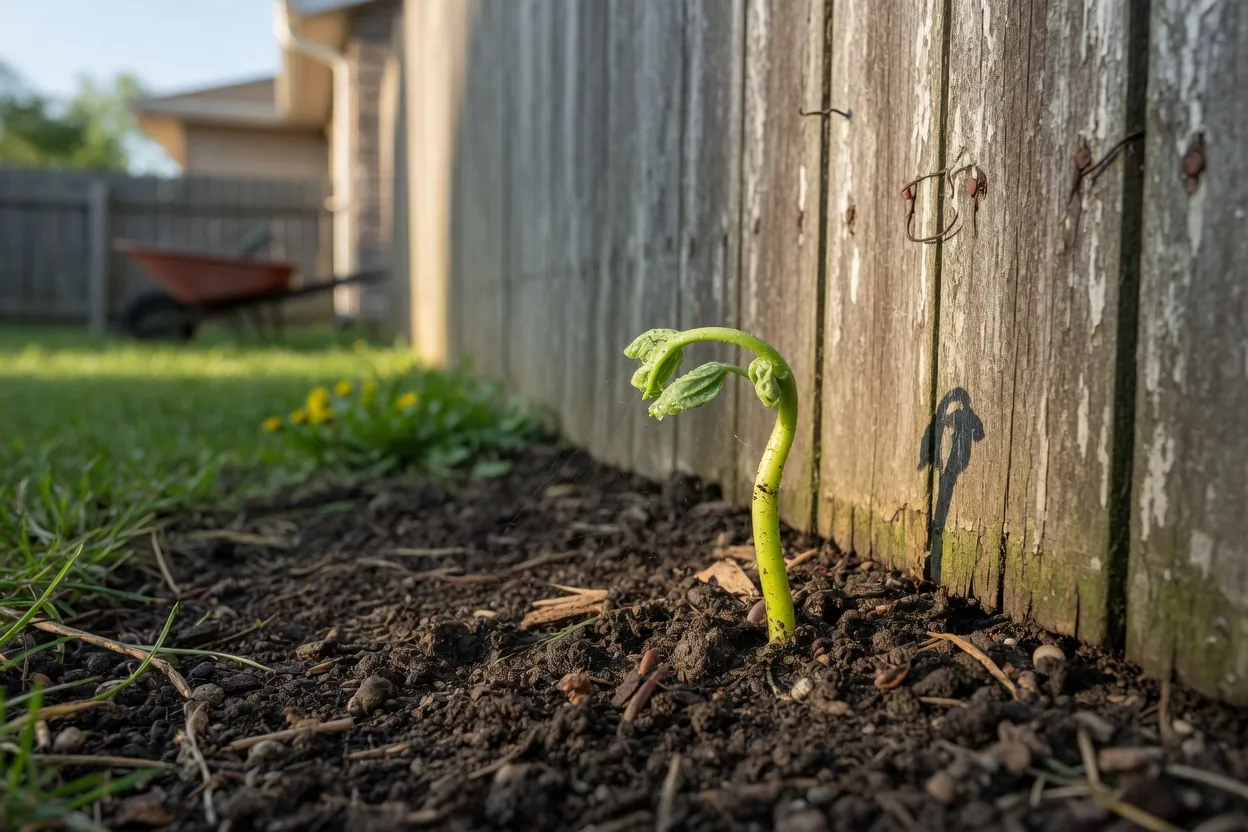
The fastest answer: if you don't know whether that green thing is a weed or a plant, leave it in the ground. Mark it, watch it for a week or two, and let it show you what it wants to be. A mystery plant in your yard almost always gives itself away with a flower bud, a spreading habit, or a smell before you have to decide anything. Waiting costs you nothing. Yanking a volunteer perennial you actually wanted costs you the perennial.
If you've been standing over a seedling wondering whether it's a weed or a plant, this is how I sort them out.
Why "Weed or Plant" Is the Wrong Question (Sort Of)
You want me to just tell you if it's a weed. But "weed" isn't a botanical category. It's an opinion.
The Royal Horticultural Society puts it plainly: a weed is simply "a plant growing where it is not wanted". The same dandelion is a weed in a putting-green lawn and a cheerful edible in someone else's wildflower patch. The Almanac, borrowing from the Weed Science Society of America, defines a weed as a plant that causes economic or ecological damage or is just undesirable where it grows, and notes that "weeds aren't inherently bad." Many stabilize soil, feed pollinators, or are edible.
So the real question isn't whether something is technically a weed. It's two questions stacked together: what is this plant, and do I want it here? You can't answer the second until you've made a decent stab at the first.
The One-Week Rule (My Favorite Lazy Trick)
When in doubt, wait. Most of the identifying features you need, like flowers, mature leaf shape, and growth habit, don't show up on a tiny seedling. They develop over the next couple of weeks.
My actual process:
- Flag it. A golf tee, a plastic knife, a chopstick, anything so you don't accidentally mow or pull it.
- Photograph it now, then again every few days, so you can track how it changes.
- Watch how it spreads. Does it stay put, or is it sending out runners and popping up three inches away? Aggressive spreading is a big tell.
- Wait for a flower or a distinctive leaf. This is usually where the mystery resolves.
The University of Minnesota Extension makes a related point about identification in general: you'll get far better results from a complete sample of several leaves, a flower, and the growth habit than from one lonely leaf. A one-week-old seedling doesn't have enough evidence on it yet. Give it time to build a case.
The exception: if it's spreading fast, or you recognize it as something genuinely nasty (more on that below), don't wait. Otherwise, patience costs you nothing.
Read the Leaves, Stems, and Roots Like Clues
While you're waiting, gather evidence. A few features are reliable because they're genetically fixed and don't change with sun, water, or soil.
Leaf arrangement
Look at how leaves attach to the stem. Are they alternate (staggered), opposite (paired at the same spot), or in whorls of three or more? This is one of the most consistent traits across species, and it's the first thing I check. Purple deadnettle and henbit have opposite leaves. Dandelion and plantain barely have a leafy stem at all. They form a basal rosette, with all leaves radiating from the crown at ground level.
Growth habit and spread
Does it grow upright, sprawl across the ground, or climb? A creeping habit is a classic weed signal. Wisconsin Horticulture describes Creeping Charlie (ground ivy) as a lawn and garden pest that thrives in moist, shady spots and is famously hard to eradicate, precisely because it creeps and roots as it goes.
Roots
If you do dig, look underground. A single deep taproot (dandelion, dock, wild carrot) behaves nothing like rhizomes or tubers that spread sideways. This matters enormously for removal later: snap a taproot and it often resprouts; leave a rhizome fragment behind and you've basically planted a new weed.
Common Weed vs. Wanted-Plant Lookalikes
This is where people get burned. Plenty of "weeds" have a nearly identical twin you'd want to keep, and the reverse is true too. A quick comparison to keep handy:
| Mystery plant | Could be a WEED... | ...or a KEEPER | Quick tell |
|---|---|---|---|
| Yellow-flower rosette | Dandelion | Young perennial like a coreopsis seedling | Dandelion's single hollow stem + jagged leaves |
| Low creeping green | Creeping Charlie / ground ivy | Ground-cover you planted (e.g. creeping thyme) | Crush a leaf — Charlie smells minty/off |
| Feathery carrot-like leaves | Wild parsnip / poison hemlock | Dill, fennel, carrot volunteers | Don't touch wild parsnip — sap burns skin |
| Tall broadleaf weed | Palmer amaranth / waterhemp | Amaranth or a sunflower volunteer | Amaranth weeds grow fast, aggressive, huge seed heads |
| Vining climber | Bindweed / Japanese honeysuckle | A clematis or morning glory you wanted | Bindweed twines and regrows from tiny root bits |
A safety note. Wisconsin Horticulture warns that contact with wild parsnip (Pastinaca sativa) can cause severe skin blisters and permanent scarring. If your mystery plant has feathery, carrot-family foliage and you aren't certain it's dill or fennel, wear gloves and don't handle it barehanded. This is one case where "wait and see" comes with "but keep your distance."
Use ID Tools — But Don't Trust Them Blindly
Photo-based plant ID has gotten good. Research on AI weed classification (WeedNet) reported overall accuracy around 97% across many species, which sounds airtight until you read the fine print and see that certain lookalike species (several Amaranthus and Setaria types) scored noticeably lower. Great at the easy calls, shakier exactly where you need the help most.
That tracks with the University of Minnesota Extension's advice: most plant ID apps rely on algorithms or crowd-sourced guesses that aren't always accurate, so always double-check the suggestion against your actual sample. Treat any tool's answer as a strong lead, not a verdict.
How I use them in practice: I'll run a photo through our weed-or-plant identifier to get a starting name, then cross-check that name against a real extension guide. NC State, for instance, points to reference works covering over 500 weed species with contrasting notes on similar plants, which is exactly the "here's how to tell it from its twin" detail an app skips. And if the plant looks sick rather than just unidentified, that's a different problem; I'll send it through the plant doctor tool to check for disease or pests instead.
When In Doubt, Here's What To Do
You've waited, you've gathered clues, you've run it through a tool, and you're still not sure. That happens. My decision tree:
- It flowered and you like it? Keep it. You got a free plant.
- It's spreading aggressively or choking neighbors? Remove it, even if you don't know the name. Aggressive spread is the single most weed-like behavior there is.
- It matches a known nasty (wild parsnip, poison hemlock, bindweed, Palmer amaranth)? Remove it, carefully, with gloves, and don't let it seed. The Almanac's number-one rule is blunt: never let 'em seed.
- It's harmless-looking and staying put? Leave it another couple of weeks. No rush.
- You truly can't tell and it's in a spot that matters? Take a full sample (leaves, flower, growth habit) to your local extension office. That's what they're there for.
One note on removal technique, because it saves you re-doing the work: pull weeds when the soil is moist, and grasp low on the stem so it doesn't snap off. For taprooted weeds like dandelion, a forked dandelion digger lets you lever the whole root out. For rhizome and tuber spreaders like nutsedge and bindweed, hand-pulling alone usually fails, since broken pieces regenerate.
Next time you're hovering over a mystery sprout with your thumb and forefinger ready, pause. Flag it, photograph it, give it a week. Let the plant make the case for itself. If you want a fast second opinion, run the photo through the weed-or-plant tool before you commit. The weeds will still be there in seven days. The volunteer flower might not survive an impatient hand.
Frequently Asked Questions
How long should I wait before deciding if something is a weed?
Give an unfamiliar seedling one to two weeks so it can develop the flowers, mature leaves, and growth habit you need to identify it. The main exception is anything spreading aggressively or matching a known toxic weed. Remove those right away.
Can a plant ID app tell me for sure if it's a weed?
It can give you a strong lead, not a guarantee. AI identification is highly accurate on easy species but weaker on close lookalikes, so the University of Minnesota Extension recommends always double-checking an app's suggestion against your actual plant and a trusted guide.
What's the easiest way to tell a weed from a flower seedling?
Watch how it behaves. Weeds tend to grow fast, spread by runners or seed, and pop up where you didn't plant anything. A wanted seedling usually stays put and eventually produces a flower or leaf you recognize, which is why the wait-and-watch approach works so well.
Is it bad to accidentally pull a "good" plant?
It's the whole reason I say wait. Many desirable volunteers and young perennials look identical to weeds at the seedling stage, and once you've pulled a taprooted or slow-growing plant, it usually doesn't come back, whereas most weeds will.
Are all weeds actually harmful?
No. As both the RHS and the Almanac point out, a weed is just a plant growing where you don't want it, and many so-called weeds stabilize soil, feed pollinators, or are edible. Whether to keep or pull is your call.