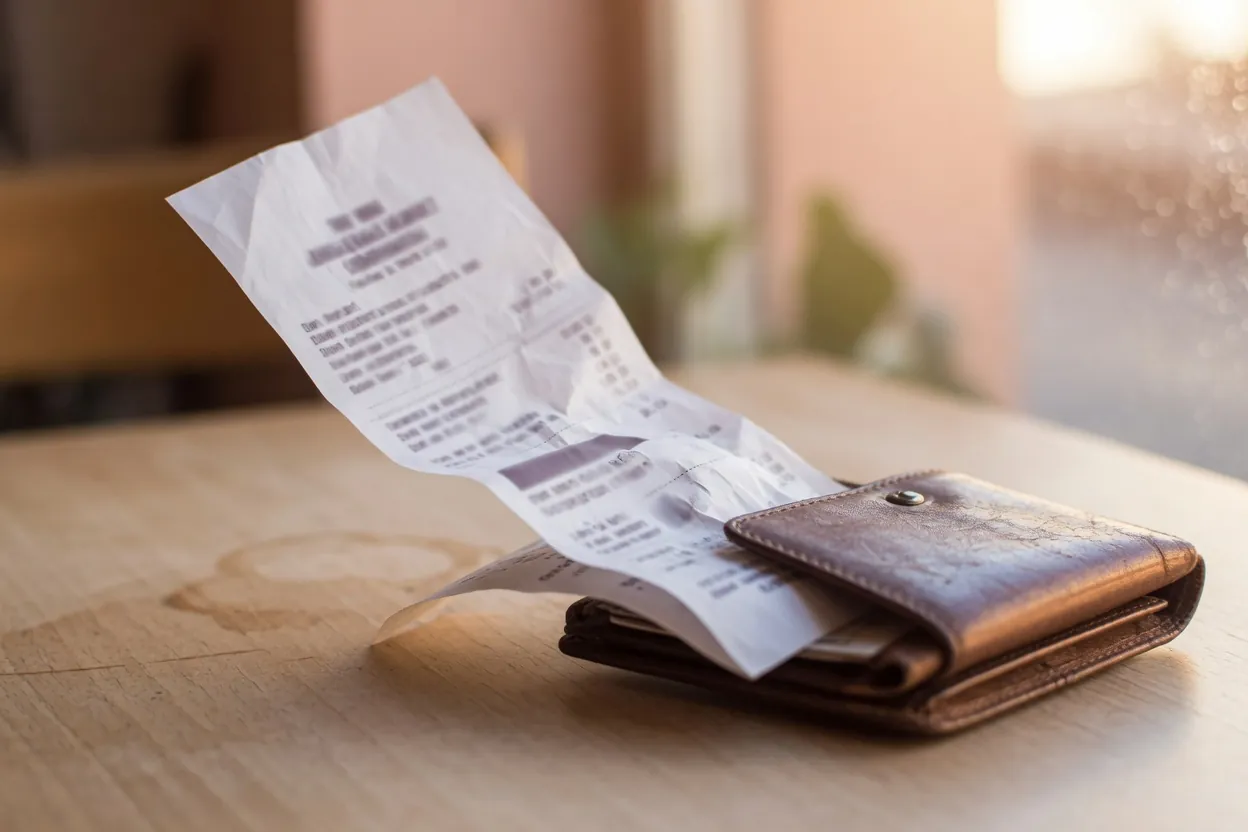
The fastest way to organize receipts for taxes: photograph each one as soon as you get it, sort it into a tax category (meals, travel, supplies, and so on), and store it in a cloud folder that mirrors your tax return. Do that all year and tax season stops being a scavenger hunt. Everything below fills in the details.
Most people land on this page because they've got a drawer, a shoebox, or a wallet stuffed with curling paper. The mess is annoying, but it isn't the real problem. The real problem is the deductions you lose when a receipt fades to a blank slip before you can use it.
Why the Shoebox Fails (and What to Do Instead)
The shoebox feels harmless. Toss a receipt in, deal with it later. But "later" is April, and by then half your thermal-paper receipts have faded to nothing. Thermal receipts really do lose their ink over a few months, which is why nearly every receipt guide tells you to capture them right away.
The paper-only approach has a bigger flaw. Even if you keep every slip, a spilled coffee or a lost folder wipes out your proof in one shot. The IRS accepts digital copies, so there's no reason to gamble your deductions on fragile paper.
The fix is to capture digitally at the point of sale. You don't need a perfect system, just a repeatable one. A tool like this receipt scanner turns a phone snapshot into a stored, searchable record in seconds, which removes the excuse most of us fall back on: "I'll file it later."
What the IRS Actually Wants You to Keep
The rules are less scary than the shoebox makes them feel. According to the IRS, your recordkeeping system only needs to clearly show your income and expenses, and your supporting documents include "sales slips, paid bills, invoices, receipts, deposit slips, and canceled checks" (What kind of records should I keep, IRS).
A valid receipt generally needs four things:
- Amount paid
- Date of the expense
- Vendor (who you paid)
- Business purpose (why it counts)
That last one trips people up. A receipt from a coffee shop means nothing on its own. Jot a quick note like "client meeting, project X" so future-you (or an auditor) knows why it's there. The IRS also lists the specific documents that back up gross receipts: cash register tapes, deposit info, receipt books, invoices, and Forms 1099-MISC (IRS).
One more point. The IRS says all the rules for paper records "also apply to electronic records" (IRS). Going digital doesn't lower the bar for accuracy. It just makes accuracy easier to hit.
What You Can Toss
Not every scrap matters. Duplicate copies, receipts for purely personal purchases with no business or deductible angle, ATM slips you've already reconciled: toss them, or don't bother scanning them in the first place. You want a clean archive, not a digital hoard.
Categories That Actually Matter at Tax Time
Sorting by date feels natural, but it's the wrong instinct. I filed chronologically for years before it clicked: at tax time, nobody asks what you spent in March. They ask how much you spent on travel. So sort by category, not date.
Use the same categories your tax form uses. For most freelancers and small businesses in the U.S., that means Schedule C lines: advertising, meals, travel, supplies, home office, vehicle. When your folders match your return, filing becomes copy-and-paste instead of detective work.
A starter category set that covers most people:
| Category | Common examples | Why it matters |
|---|---|---|
| Meals | Client lunches, business coffee | Note who + purpose on each |
| Travel | Flights, hotels, rideshare | Keep itineraries too |
| Supplies | Software, office goods | Small stuff adds up fast |
| Home office | Utilities %, internet | Needs consistent tracking |
| Vehicle | Gas, mileage, repairs | Log date + purpose + miles |
| Advertising | Ads, website, business cards | Directly deductible |
The IRS groups deductible business expenses into topics like rent, taxes, and insurance in its Guide to business expense resources, which is worth a skim if you're unsure where something belongs.
How Long to Keep Receipts
Keep them longer than you think you need to. Federal guidance points you toward keeping records that support items on your return, and for the full detail, the IRS directs readers to Publication 583, Starting a Business and Keeping Records (IRS).
The practical rule most tax pros land on: hang onto receipts for at least three years, and stretch to seven if you want an extra buffer. Digital storage makes this painless. A folder from 2021 costs you nothing to keep, unlike a physical box eating your closet.
Even after the tax window closes, don't shred blindly. You might want records for warranties, insurance claims, or a big-ticket asset you're still using. Keeping is cheap. Regret is expensive.
Your Digital Receipt Workflow, Step by Step
A good workflow is one you'll actually stick to, so keep it dumb-simple. This is the one I recommend:
- Capture immediately. Snap or scan every receipt the moment it lands in your hand, before the ink fades and before it disappears into the couch. A receipt scanner makes this a two-second habit.
- Categorize on the spot. Tag it (meals, travel, supplies) right after capture, while you still remember what it was for.
- Add the business purpose. One line. "Coffee w/ [client]." Done.
- Store with backup. Use a folder structure that makes sense. I use
2026 > Category. Cloud storage means a dead laptop won't erase your year. - Reconcile monthly. Once a month, match receipts against your bank and card statements. Catching a gap in month two beats discovering it in April.
That fifth step is the one everyone skips and everyone regrets. A monthly check-in turns tax prep from a marathon into a formality. You're not doing taxes in April. You've been quietly doing them all year.
For Households, Not Just Freelancers
If you're not self-employed, this system still works for deductible personal spending: medical expenses, charitable donations, childcare, energy-efficiency purchases. Same idea: capture, categorize, store. And while you're organizing your money anyway, a quick pass with a bill negotiator can trim the recurring bills whose receipts you're filing in the first place.
Digital vs. Paper: A Quick Comparison
Still tempted to stick with paper? The trade-offs are worth laying out plainly.
| Digital receipts | Paper receipts | |
|---|---|---|
| Durability | Doesn't fade | Fades in months |
| Searchable | Yes, instantly | No, manual dig |
| Backup | Cloud copies | One copy, one fire |
| IRS accepted | Yes | Yes |
| Space | None | A whole drawer |
| Effort at tax time | Low | High |
Paper isn't wrong. The IRS takes it. But digital wins on every axis that matters when you're stressed and staring down a deadline. If you want to keep paper originals for a few big purchases like assets or warranties, fine. Just don't make paper your only line of defense.
Pick your capture tool today rather than next week, and scan the next receipt you get. That single habit, repeated, is the whole difference between a shoebox and a system.
Frequently Asked Questions
Does the IRS accept digital or scanned receipts?
Yes. The IRS states that all requirements applying to paper books and records also apply to electronic records, so scanned and photographed receipts are acceptable as long as they're accurate and legible (IRS). Just keep your digital files orderly in case there's ever a question.
What information does a valid tax receipt need?
At minimum, capture the amount, date, and vendor, plus a note on the business purpose. That business-purpose note is what turns a random slip into a defensible deduction, so add it the same day you capture the receipt.
How should I categorize receipts for taxes?
Sort by expense category rather than by date, and match those categories to your tax form (for many U.S. filers, that's Schedule C lines like meals, travel, supplies, and home office). When your folders mirror your return, filing becomes fast instead of frustrating.
How long should I keep my receipts?
A safe rule is three years at minimum, extending toward seven if you want a bigger buffer. The IRS points to Publication 583 for the full recordkeeping guidance (IRS). Since digital storage is essentially free, keeping records on the longer side is the low-risk choice.
Do I really need to keep small receipts under a few dollars?
For minor expenses, a same-day log entry can be enough. But if you're already scanning as you go, capturing the small ones costs you nothing. Little expenses add up across a year, and it's easier to have proof and not need it than the reverse.