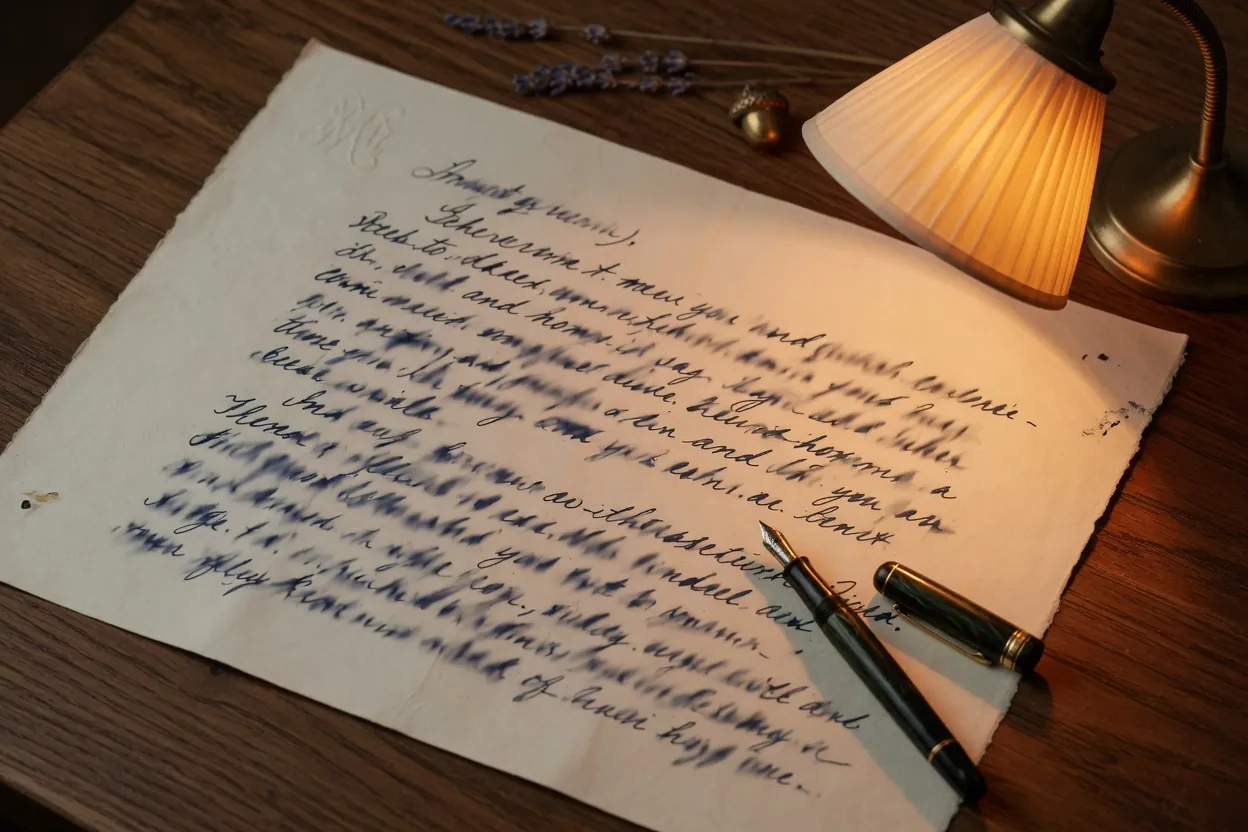
The ink on grandma's recipe card has faded, the loops blur together, and half the words could pass for a seismograph reading. Old handwriting looks impossible until you know a few tricks, and none of them require special training.
The method breaks down into three steps: read the whole thing once to get a feel for it, transcribe the letters you can read, and use those to work out the ones you can't. Context fills the gaps. Everything below is detail on how to do that well.
Start With One Full Read (Don't Fight Word by Word Yet)
Most people stop dead at the first illegible word. That's the mistake. Read the whole document — or the whole recipe card — start to finish, even if a third of it is guesswork.
Your brain has to learn one specific person's handwriting before it can decode the hard parts. The way someone writes an "r" in one word is the way they write it everywhere. The Library of Virginia's transcription tips recommend comparing letters across words within the same document and leaning on context clues: is it a place name, a cooking term, a legal phrase?
On that first pass, get the gist. What is this — a letter, a will, a recipe, a census page? Once you know the type of document, you know what words to expect, and expecting a word is half the battle to reading it.
Build Your Own Alphabet From the Letters You Recognize
This technique comes straight from the archivists, and it's the one I reach for most. Transcribe letter by letter, mark anything you can't read with a question mark, then go back and do a second pass looking for whole words.
The Center for Family History's tips for reading old handwriting lay out this exact sequence: transcribe letter by letter, do a second pass for words, then use the words you've already cracked as comparison examples for the ones you haven't. It works because handwriting is consistent. Find a clear "th" in a word you already know, and you can spot "th" everywhere else.
Make a mini reference sheet
Grab a scrap of paper and jot down each letter as you confirm it. This becomes a cheat sheet for the writer's personal alphabet. Capital letters cause the most trouble — capital S, L, T, and F fool everyone — so nail those down early.
- Compare like with like. A weird squiggle in one word probably matches a clearer version elsewhere.
- Mark, don't guess wildly. Use
[illegible]or a?for anything you truly can't read. The National Archives transcription guidance recommends this too — brackets for uncertain or crossed-out text, and "do your best and use your best judgement." - Revisit the opening. After you've read the whole thing, the first few lines get much easier.
Old Letterforms That Trip People Up
Some old letters just don't look the way we expect anymore. Once you know the usual suspects, you'll stop tripping over them.
The famous one is the "long s" (ſ), which looks like an "f" without the crossbar. So "Congreſs" reads like "Congrefs," and an old recipe that says "paſs the batter" isn't asking you to fumble it. You'll also see doubled letters, flourishes on capitals that mean nothing, and spelling that was never standardized — people wrote words however they sounded.
Spelling is a real hurdle, and it helps to know why. According to Who Do You Think You Are? Magazine's guide to old handwriting, Latin was the official language in most English documentation until 1733, and formal "Legal hand" persisted in court records until an Act in 1731 phased it out. If you're staring at genuinely old records and the words look like no English you know, they may not be English.
For documents from roughly 1500 to 1800, the UK's National Archives palaeography tutorials are free, interactive, and worth the practice. They also cover Roman numerals and old currency, which show up constantly in ledgers and receipts.
Recipe Cards Are Their Own Puzzle
Recipes add one more challenge: vague measurements. Read every word perfectly and "a gill of cream" or "a knob of butter" still won't tell a modern cook much. Reading the handwriting is only step one. Decoding the quantities is step two.
Here's a starter conversion for the terms that trip people up most:
| Old term | Roughly means |
|---|---|
| A gill | About ½ cup |
| A teacup | About ½ to ¾ cup |
| A wineglass | About ¼ cup |
| A dessertspoon | About 2 teaspoons |
| A knob of butter | 1 to 2 tablespoons |
| A pinch | About ⅛ teaspoon |
| A smidgen | About half a pinch |
These are estimates, not exact science. Historic British and American gills differ slightly, and a "teacup" depended on the actual teacup someone happened to own. Treat them as a starting point and adjust to taste.
And when the card says "cook until it looks right"? That isn't decodable — it's inherited knowledge. Your best bet there is a family member who's made the dish, which leads to the next point.
Scan It Before You Do Anything Else
Before you spend an hour squinting, take a good photo. Partly to preserve it — these cards are one spilled coffee away from gone — but mostly because zooming in on a clean, well-lit image beats reading a faded card under kitchen light.
The trick is contrast. Place the card on a flat, dark surface and use bright, even light, either natural daylight or a good lamp. Your phone already has a document scanner built in. On iPhone, open Notes, tap the camera icon, and choose Scan Documents. On Android, open Google Drive, tap +, and choose Scan. Both produce a clean, cropped image you can enlarge and share.
Once it's digital, you can zoom, adjust brightness, and get help from other eyes without mailing the fragile original around. A digital copy also means the recipe survives even if the card doesn't.
When to Bring in Help (Human or AI)
Sometimes you've done every trick and a word still won't budge. That happens to experienced transcribers too, so here's when to stop grinding and get help.
Try AI transcription for the tough documents. Purpose-built handwritten text recognition (HTR) tools handle manuscript hands far better than generic OCR. Transkribus, widely used by archivists and genealogists, reports having deciphered over 200 million pages across 100+ languages. It gives you a rough transcription you then correct, which is a huge head start on a hard page. For a quick, no-setup read of a single letter or card, an AI handwriting reader can turn a photo into text you can work with.
One caveat: AI isn't magic. Very old, faded, or heavily stylized cursive still needs human correction, and general-purpose chatbots can produce fluent-looking text that quietly hides its errors. Always check the output against the original.
Ask a human for the stuff AI can't get. For a recipe's "cook until done," or a name only a relative would recognize, the best transcription tool is a phone call to family. When you're capturing those stories and interpretations, a tool like family stories helps you record the context — the who, when, and why — alongside the words themselves. That context is what makes an old document mean something.
Transcribe what you can, scan early, lean on AI for the grind, and lean on people for the memory. Pour a cup of tea and start with one full read. Most of it comes back by the second pass.
Frequently Asked Questions
Why can't I read old cursive even though I learned cursive in school?
Modern cursive and historical hands aren't the same alphabet. Old documents use letterforms like the "long s," inconsistent spelling, and flourishes that were never taught in modern classrooms, so it's less about your reading ability and more about unfamiliar shapes.
What's the fastest way to decipher old letters I can't make out?
Read the whole thing once for context, then transcribe the letters you can read and use them to crack the rest. Marking unreadable words with a ? and comparing repeated letters within the same document, as the National Archives recommends, does most of the work.
Can AI really handle old recipe card translation?
Sometimes, yes. A purpose-built handwriting reader can turn a clear photo into editable text in seconds. But faded ink, stains, and cursive shorthand often need manual correction, and vague measurements like "a gill" still need a conversion chart or a family member to interpret.
How should I scan a fragile old document?
Use your phone's built-in document scanner (Notes on iPhone, Google Drive on Android), place the item on a flat dark surface, and light it evenly with daylight or a bright lamp. Good contrast makes both your reading and any AI tool far more accurate.
Where can I practice reading really old handwriting?
The UK's National Archives palaeography tutorials offer free interactive lessons for documents from 1500 to 1800, plus guides to Roman numerals and old currency. The Library of Virginia also publishes helpful tips and abbreviation charts.