A squeal. A knock. A click every time you turn left. Something your car wasn't doing last week. Your stomach drops a little.
You don't need to panic, and you don't need to hand your keys to a mechanic and hope for the best. You need a way to figure out what the noise actually means — so you can make a smart call about what to do next.
This guide covers the most common car sounds, what they likely mean, which ones need immediate attention versus a watchful eye, and how to use a free AI car noise identifier to get a plain-English answer before you ever set foot in a shop.
What You'll Need
- Your phone (to record the noise or describe it to an AI tool)
- A quiet moment to actually listen to your car
- Basic details about your vehicle: year, make, model, and approximate mileage
- Five to ten minutes
Estimated Time: 10–15 minutes Difficulty Level: Beginner — no mechanical knowledge required
Step 1: Stop Guessing and Start Listening Carefully
Most people hear a noise and immediately spiral — it's the engine, it's going to cost $4,000, I'm stranded — without paying attention to what they're actually hearing. Those details are what get you a useful diagnosis.
Before you describe your car noise to anyone, answer these questions:
- When does it happen? Only when braking? Only when turning? At highway speeds? When the engine is cold?
- Where does it seem to come from? Front left wheel? Under the hood? Somewhere in the dashboard?
- What does it sound like? Squealing, grinding, knocking, clicking, rattling, whining, clunking?
- Is it constant or intermittent? Does it get worse when you accelerate or slow down?
Write these down — even just in your Notes app. The more specific you are, the better your diagnosis will be. An AI tool can work with vague descriptions, but precise ones get you much further.
Step 2: Match Your Sound to the Most Common Car Noise Categories
Six sounds come up more than any others. Here's what they typically mean and how urgent each one is. Think of this as a starting point, not a final answer.
Squealing When You Brake
Most likely cause: Worn brake pads. Most pads have a metal wear indicator built in specifically to make this noise when they get low.
Urgency: Medium-high. If the squeal turns into grinding when you brake, the pads are completely gone and you're chewing through your rotors. That repair costs significantly more than a simple pad replacement. Choice Auto Repair's guide to vehicle noises puts brake sounds in the "address promptly" category — don't sit on this for weeks.
Clicking Noise When Turning
A clicking noise when turning is one of the most searched car noise questions out there. It almost always points to a worn CV (constant velocity) axle joint. The clicking typically comes from one side and gets faster as you speed up through the turn.
Urgency: Medium. A failing CV joint won't strand you immediately, but it will eventually — and these tend to let go at the worst possible moments, like merging onto a highway.
Grinding Sound (General)
Grinding is rarely good news. Location and timing matter:
- Grinding when braking — metal-on-metal brake contact. Act fast.
- Grinding when shifting — possible transmission or clutch issue.
- Grinding from a wheel — could be a failing wheel bearing.
Urgency: High for anything braking-related. Get it looked at soon.
Knocking or Pinging from the Engine
A deep, rhythmic knock from the engine — sometimes called rod knock — can point to low oil pressure, worn bearings, or detonation. A lighter pinging sound under acceleration often means the engine is running on fuel with too low an octane rating.
Urgency: Rod knock means stop driving and call a mechanic. Pinging on acceleration: try higher-octane fuel first, then get it checked if the problem sticks around.
Rattling (Exhaust or Undercarriage)
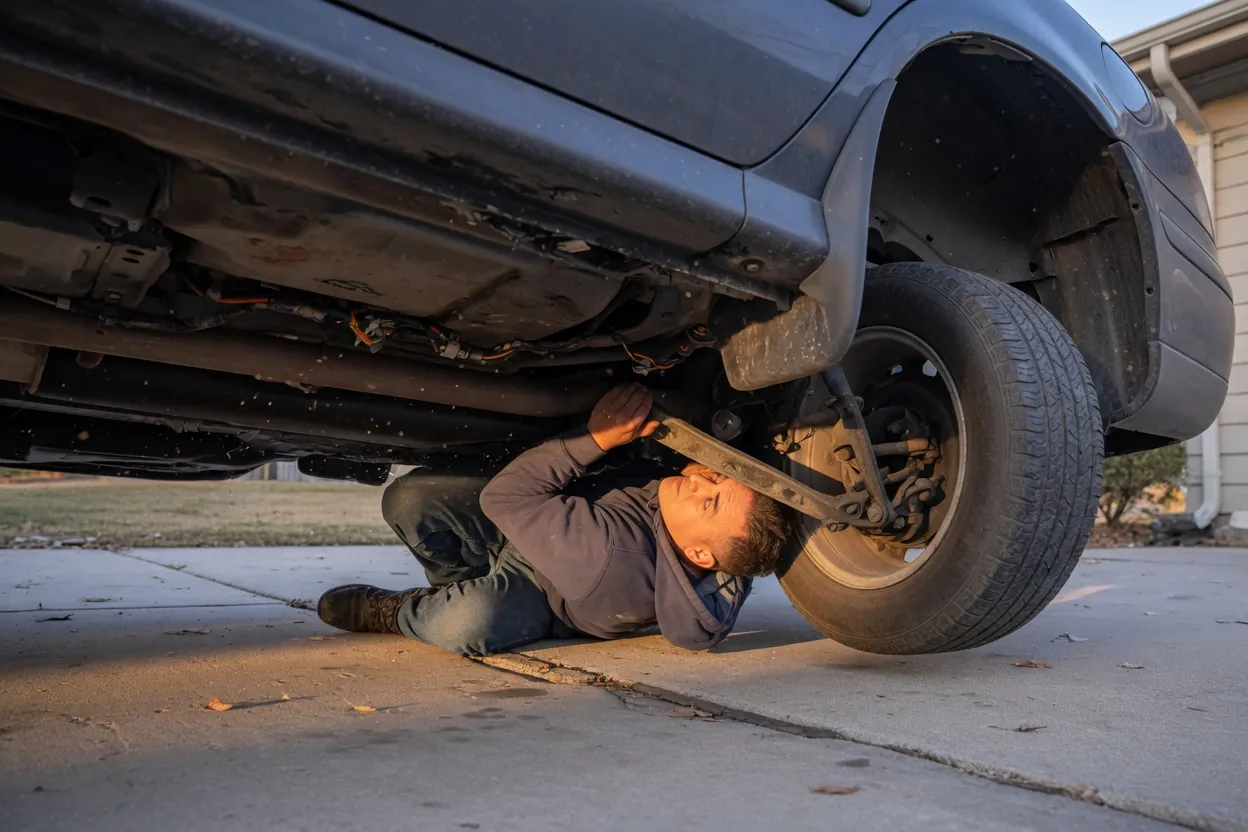
A rattle from underneath — especially at idle or low speeds — is often a loose heat shield on the exhaust. Annoying, but usually not dangerous. That said, context matters: a Ford Explorer owner in a 2025+ Explorer ST Forum thread described a similar metal-on-metal rattle that turned out to be cracked strut mounts.
Urgency: Low to medium. Worth investigating, but probably not an emergency.
Whining from the Front of the Car
A high-pitched whine that changes with steering input usually means low or degraded power steering fluid. A whine that climbs with engine RPM could be an alternator, power steering pump, or serpentine belt.
Urgency: Medium. Check your power steering fluid level first — it takes about 30 seconds. If the fluid is fine, get it diagnosed.
Step 3: Use a Free AI Car Noise Identifier to Get a Real Diagnosis
Instead of spending an hour in Reddit threads or paying a shop $150 just to name the problem, you can describe your sound to an AI tool and get a structured answer in about two minutes.
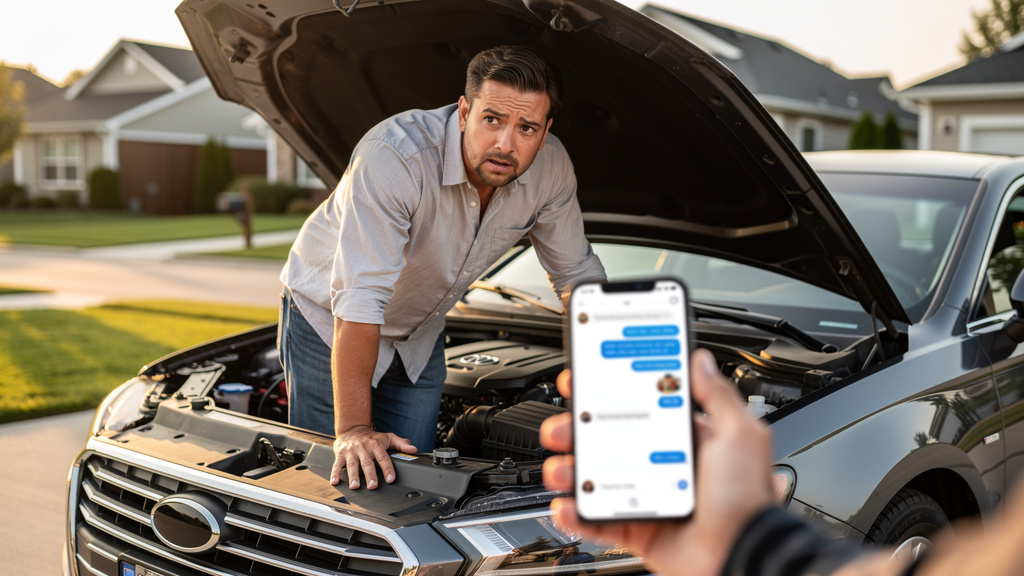
The better tools don't give you a one-liner — they give you confidence levels, likely causes, and an urgency assessment. Tools like MyAutoSound let you record the sound directly, answer a few questions about when and where it happens, and get a focused diagnosis before you spend a dime at a garage. The framing is right: it doesn't replace your mechanic, it helps you show up with better information.
Here's how to get the most out of an AI car sound diagnosis tool:
1. Go to the tool. Try EasyAI's free car sound diagnosis tool — no login required, works on mobile.
2. Describe the sound in detail. Use the notes you made in Step 1. A useful prompt looks like this:
"My 2019 Honda CR-V makes a clicking sound from the front left wheel area only when I'm turning right at low speeds. It started about two weeks ago and seems to be getting louder. The car has 67,000 miles."
That's far more useful than "my car is clicking."
3. Include what you've already ruled out. If you checked the power steering fluid and it's fine, say so. If the noise only happens when the engine is warm, mention it.
4. Read the full response. A good AI diagnosis gives you two or three likely causes ranked by probability, flags which is most urgent, and suggests what to tell your mechanic.
5. Ask follow-up questions. This is where AI beats a static website. You can ask: "What does it cost to fix a CV joint on a 2019 CR-V?" or "Is it safe to drive 50 miles to the dealership with this issue?"
Step 4: Decide Whether to Drive, Wait, or Call Now
Not every noise is an emergency. Some absolutely are.
| Sound | Safe to Drive? | How Soon to Act |
|---|---|---|
| Brake squeal (pads wearing) | Yes, short-term | Within 1–2 weeks |
| Grinding when braking | No | Today |
| CV joint clicking when turning | Yes, carefully | Within 1–2 weeks |
| Engine knocking (deep) | No | Stop driving |
| Exhaust rattle | Yes | Within a month |
| Power steering whine | Yes, carefully | Within a week |
When you're not sure, use the EasyAI fix-or-call tool to figure out whether this is a DIY situation, a "book an appointment" situation, or a "don't start the car again" situation.
Step 5: Talk to Your Mechanic Like You Know What You're Talking About
The point of diagnosing your car sound with AI isn't to become your own mechanic — it's to walk into the shop with a hypothesis instead of a shrug.
When you say "I think it might be a CV axle joint on the front left — it clicks when turning right and the noise has been getting worse over two weeks", a good mechanic will take that seriously. They'll know you're not going to be upsold on something unrelated. And if they come back with a different diagnosis, you can ask intelligent follow-up questions instead of just nodding along.
Having even a rough idea of what's wrong — and what it should cost — changes the whole dynamic of that conversation. The EasyAI should-I-buy-this tool can help you weigh repair estimates if you're trying to decide between fixing an older car and moving on.
Troubleshooting: When the AI Diagnosis Doesn't Quite Fit
The sound is hard to describe in words. Try recording it on your phone and using an app like DriveVerse or AutoSonic that can analyze actual audio. OPENLANE's AI audio tool — used in the used-car industry — analyzes engine recordings against a database of over 1.2 million engine profiles, which gives you a sense of how far this technology has come.
The diagnosis gives you multiple possibilities. That's normal and honest. Ask the AI: "Which of these is most likely given that the noise only happens when the engine is cold?" Narrowing the conditions narrows the diagnosis.
The mechanic disagrees with the AI. Ask them to walk you through their reasoning. A good mechanic won't be bothered by the question — and if they can't explain why they're landing somewhere different, that's useful information too.
What's Next
Once you've got a diagnosis in hand:
- Get a repair estimate before you go to the shop — use the EasyAI fix-or-call tool to get a sense of what a fair price looks like
- Search your specific car and noise combination on forums like Reddit's r/MechanicAdvice — owners with the same vehicle and same symptom are often the best secondary source
- If you're deciding whether to repair or replace, the EasyAI should-I-buy-this tool can help you think through whether the repair cost makes sense against what the car is worth
- Keep a log — apps like DriveVerse let you track symptoms over time, which matters when a noise is intermittent and hard to reproduce in the shop
FAQ
Can an AI actually diagnose a car noise accurately?
AI car noise tools are surprisingly good at narrowing down likely causes from a detailed description. MongoDB's automotive AI research notes that AI can cut diagnostic time significantly by comparing symptoms against large databases of known issues. They're not perfect, but they give you a real starting point — and a much better one than a generic Google search.
Is it safe to keep driving if my car is making a weird noise?
It depends entirely on the noise. A rattling exhaust heat shield is probably fine for a while. Grinding when you brake, or a deep engine knock, means stop driving and get it checked right away. When you're not sure, the EasyAI fix-or-call tool can help you assess how urgent the situation actually is.
What's the best free AI tool to diagnose car sounds?
For text-based descriptions, EasyAI's car sound diagnosis tool is a solid no-login option. For actual audio recording and analysis, MyAutoSound and DriveVerse both offer AI-powered sound diagnostics with severity ratings and estimated repair costs.
My car only makes the noise sometimes. How do I diagnose an intermittent sound?
Intermittent noises are the hardest to pin down — even for experienced mechanics. Log every detail when it does happen: outside temperature, your speed, road surface, steering position, and how long it lasts. Apps like DriveVerse are built for exactly this — they let you track patterns over time so the diagnosis gets sharper with each occurrence.
Will telling a mechanic my AI diagnosis annoy them?
Most mechanics appreciate a customer who's done some homework. Frame it as a hypothesis, not a verdict: "I think it might be the CV joint — does that match what you're hearing?" That opens a conversation. Walking in and saying "The AI told me it's definitely the CV joint, just replace it" closes one.
How do I describe a car noise I can't quite name?
Use comparisons. "It sounds like a playing card caught in bicycle spokes" or "like someone dragging a metal rod along a fence" is far more useful than "it's kind of a rattling noise." Focus on rhythm (steady versus intermittent), pitch (high squeal versus low thud), and what changes it — speed, steering input, braking, temperature.