That flash of red at your feeder this morning — was it a cardinal? A house finch? Something you've never seen before? If you've ever squinted out your kitchen window wondering "what bird is that?", you're in exactly the right place. Learning to identify birds in your backyard is one of those skills that sounds niche until you try it — and then suddenly you can't stop. This guide will walk you through every step: what to look for, which common backyard birds you're most likely to see by region, the best times to watch, and how a free AI bird identifier can name that mystery bird from a photo in seconds.
Estimated time: 15–30 minutes to learn the basics; a lifetime to enjoy it Difficulty level: Beginner-friendly — no experience required
What you'll need
- A window with a yard view, porch, or outdoor space
- A smartphone with a camera (any modern phone works)
- The Merlin Bird ID app (free, iOS and Android) — developed by the Cornell Lab of Ornithology, it covers 10,000+ species and has been downloaded over 10 million times
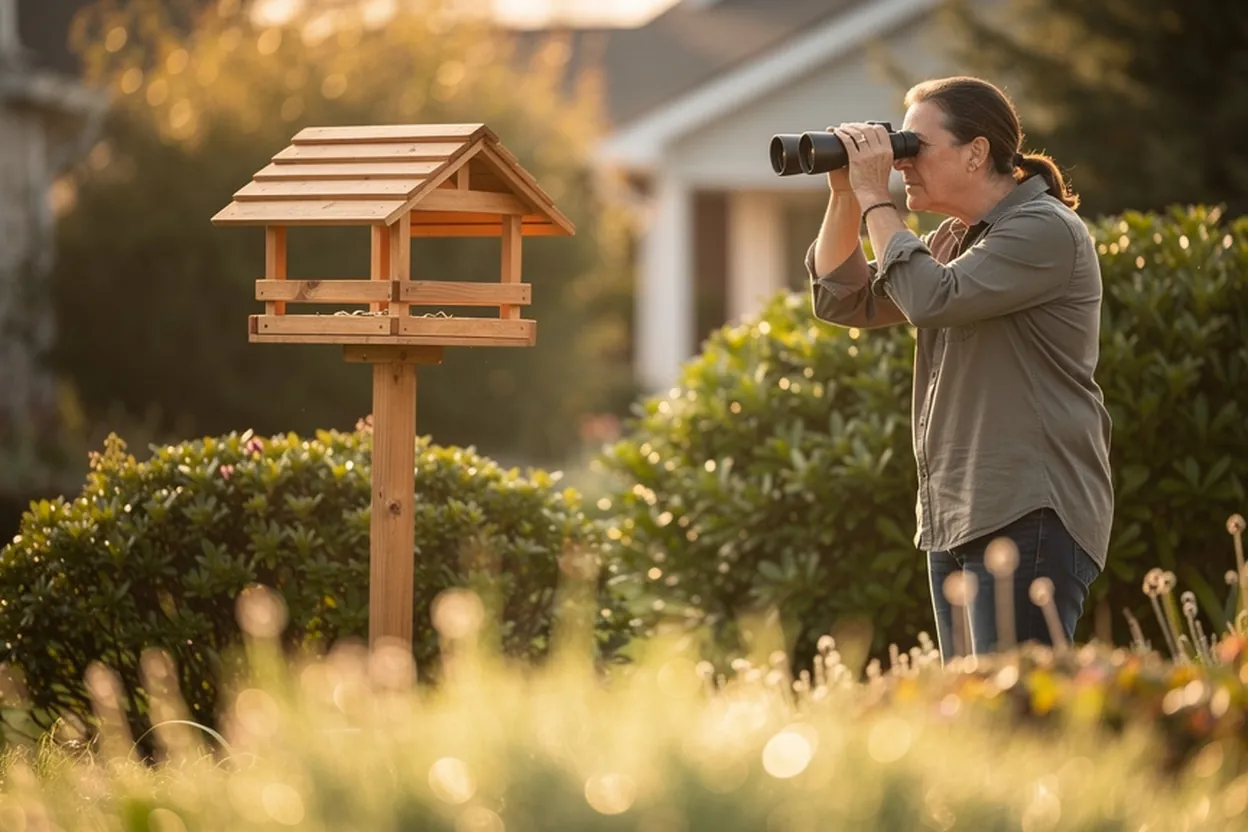
- Optional: a basic pair of binoculars (8x42 magnification is ideal for beginners)
- Optional: a regional field guide or the free Audubon Bird Guide app
- Five minutes of patience — birds reward the still and the quiet
Step 1: Set up your backyard bird-watching station
Before you can identify a bird, you need birds to identify. That sounds obvious, but this step matters more than many new birders expect.
The single fastest way to get birds into view is to put out a feeder. A basic tube feeder filled with black-oil sunflower seeds attracts the widest variety of species. Add a shallow birdbath within sight of your window, and you've basically built a bird magnet. Position everything within 10–15 feet of a window so you can see field marks (the specific color patches, beak shapes, and markings that separate species) without needing binoculars.
If you don't want to install a feeder right now, that's fine too. Just pick a comfortable spot near a window and give yourself a clear sightline to trees, shrubs, or your lawn. Early morning is prime time — more on that in Step 3.
Step 2: Learn the key field marks to look for
Here's where most beginners get overwhelmed. They see a bird, try to memorize every detail at once, and end up remembering nothing. What actually works is training yourself to notice a short checklist of features in order. According to Mississippi State University Extension, focusing on size, shape, and color pattern — in that sequence — is the most reliable approach.
Size and shape first
Compare the bird to something you already know. Is it smaller than a robin? Bigger than a sparrow? Roughly crow-sized? This narrows your options dramatically before you even look at color. Also check the beak: short and stubby (seed-eater), long and thin (insect-prober), or hooked (predator)?
Color pattern second
Don't just think "it's red." Ask where the red is. A male Northern Cardinal is entirely red with a crest and a black mask. A House Finch is red only on its head and chest, with streaky brown elsewhere. Same color, completely different birds. Look for:
- Wing bars — thin stripes across the folded wing
- Eye rings — pale circles around the eye
- Breast markings — spotted, streaked, or plain?
- Tail shape — forked, rounded, or squared off?
Behavior third
A bird's behavior is often its best ID clue. Nuthatches walk headfirst down tree trunks — nothing else does that. American Robins run-stop-tilt on lawns in a very specific pattern. Hummingbirds hover. Blue Jays are loud and bossy at feeders. You'll start recognizing these patterns faster than you expect.
Step 3: Know the most common backyard birds by region
"Common backyard birds" means something very different in Maine versus Arizona. Here's a quick regional breakdown of what you're most likely to see, based on data from American Bird Conservancy:
Eastern United States
| Bird | Key field marks | Fun behavior |
|---|---|---|
| Northern Cardinal | Male: all-red with crest and black mask. Female: warm brown with red tinge | Male feeds female during courtship |
| Blue Jay | Bold blue, white, and black; loud crest | Mimics hawk calls to scare other birds away |
| American Robin | Orange-red breast, dark back, yellow beak | Tilts head to listen for earthworms |
| House Sparrow | Brown streaked, males have black bib | Extremely social; travels in flocks |
| Ruby-throated Hummingbird | Iridescent green back; male has brilliant red throat | Only hummingbird species in the East |
| House Finch | Red head/chest on males, streaky brown overall | Cheerful warbling song at feeders |
Western United States
- Anna's Hummingbird — year-round resident; male has a rose-pink head and throat (not just the throat like Eastern species)
- Black-billed Magpie — unmistakable: black and white with an extraordinarily long tail
- Lesser Goldfinch — tiny, yellow-green; often seen in flocks on thistle feeders
- Spotted Towhee — rufous sides, white spots on black wings; scratches loudly in leaf litter
- Rufous Hummingbird — fiery orange-red; one of the most aggressive hummingbirds you'll meet
Nationwide (you'll see these almost anywhere)
- American Goldfinch — brilliant yellow in summer, olive-drab in winter (same bird, different season — this trips people up constantly)
- Black-capped Chickadee — tiny, bold, and utterly fearless at feeders
- Mourning Dove — soft gray-brown, small head, long pointed tail; coos mournfully
- Downy Woodpecker — smallest North American woodpecker; males have a small red patch on the back of the head
Step 4: Time your bird watching for best results
Timing makes a noticeable difference. Starting at 9am can mean missing some of the busiest activity of the day.
The first 1–2 hours after sunrise is peak bird activity — this is called the "dawn chorus" and it's when birds are most active feeding and singing. Pennington Seed's birding guide confirms that early morning consistently yields the most species variety. A second, smaller activity window happens in the late afternoon, about 2 hours before sunset.
Midday? Birds rest, preen, and stay cool. You'll see some activity, but it's slow. If you only have 15 minutes to watch, spend them right after sunrise.
Seasonal tip: Winter is actually fantastic for backyard bird watching. Leaves are gone, so birds are easier to spot, and many species concentrate at feeders when natural food is scarce. The annual Great Backyard Bird Count happens every February for exactly this reason — in 2026, it generated over 1.2 million saved Merlin Bird IDs alone.
Step 5: Use a free AI bird identifier to name unknown birds
This is where things have genuinely changed in the last few years. You no longer need to be an expert to identify a bird from a photo. AI-powered apps can do it in seconds — and they're surprisingly accurate.
The best free option right now is the Merlin Bird ID app by Cornell Lab of Ornithology. Here's exactly how to use its photo identification feature:
- Download Merlin from the App Store or Google Play (it's completely free)
- Open the app and tap "Identify a Bird"
- Select "Photo" — you can snap a new photo or upload one from your camera roll
- Merlin analyzes the image and returns a short list of likely species, usually within 3–5 seconds
- Tap each result to see photos, range maps, and audio so you can confirm the match
Photo ID covers over 8,000 species and works completely offline. According to CurlewCall's 2025 app review, modern bird ID apps achieve 85–95% accuracy for common North American species under good lighting conditions.
You can also try the EasyAI Bird Identifier — just upload a photo directly in your browser, no app download required. It's a solid option if you're on a desktop or want a second opinion on a tricky ID.
Pro tip: The more of the bird you can capture in frame — ideally showing the full body with good light — the better your results. Blurry, backlit, or heavily cropped photos will lower accuracy.
Step 6: Keep a simple bird journal (it makes you better, fast)
A bird journal may sound fussy, but even jotting down three words — "small, yellow, feeder" — after each sighting creates a useful reference. Over time, those notes can reveal patterns in which birds visit and when they appear.
You don't need anything special. A notes app on your phone works perfectly. Record:
- Date and time
- Location (your yard, a park, etc.)
- What you saw — size, color, behavior, any sounds
- Your best guess at the species
If you want something more structured, the eBird app (also free, also by Cornell Lab) lets you log sightings that contribute to actual scientific research. Over 1 million eBird submissions came from the US alone during the 2026 Great Backyard Bird Count. Your backyard sightings genuinely matter to researchers tracking bird populations.
Common issues and troubleshooting
"The bird flew away before I could get a good look." This happens constantly. Don't chase it — just note whatever you caught (size, color flash, flight pattern) and check your field guide or app afterward. Over time, you'll get faster at locking onto key features.
"My photo ID result doesn't look right." Try again with a clearer or better-lit photo. Make sure your location settings are enabled in Merlin — the app uses your geographic location to filter results to species actually found in your area, which dramatically improves accuracy.
"I'm seeing a bird that isn't in any of my guides." Juvenile birds and females of many species look completely different from the males shown in most guides. A female cardinal, for example, looks nothing like the iconic red male — she's warm brown with just a hint of red. Search specifically for "[species name] female" or "[species name] juvenile."
"I can hear a bird but can't see it." Use Merlin's Sound ID feature. Open the app, tap "Sound ID," and hold your phone toward the sound. Merlin will identify birds in real time from their calls — it's kind of remarkable, honestly. Works offline too.
"I found an insect or plant I can't identify either." The same AI approach works for other backyard wildlife. The EasyAI Bug Identifier can name insects from a photo, and the EasyAI Plant Doctor can identify plants and flag what's wrong with them. Your whole backyard ecosystem, decoded.
What's next
Once you've nailed the regulars at your feeder, here's where to go next:
- Join the Great Backyard Bird Count — it runs every February for at least 15 minutes of counting. Your data goes directly to Cornell Lab and Audubon. Sign up at birdcount.org.
- Add a hummingbird feeder — fill it with a 4:1 water-to-white-sugar solution (no red dye needed) and prepare to be obsessed.
- Explore your local Christmas Bird Count — held every December/January, these community events are a great way to meet experienced birders in your area.
- Try birding by ear — learning 10–15 common bird songs will transform your walks. Merlin's Sound ID is the fastest way to start.
- Download a regional field guide — the Sibley Guide or National Geographic Field Guide are both worth having for going deeper than an app can take you.
Frequently asked questions
What's the best free app to identify a bird from a photo?
Merlin Bird ID by Cornell Lab of Ornithology is the strongest free option out there. It covers 8,000+ species, works offline, and returns results in seconds. The EasyAI Bird Identifier is another good browser-based option that requires no download.
What bird is this — red all over, with a crest?
Almost certainly a male Northern Cardinal (Cardinalis cardinalis). It's one of the most recognizable backyard birds in the eastern US. If the red is only on the head and chest with brown streaking on the body, you're looking at a male House Finch instead.
What time of day is best for backyard bird watching?
The first one to two hours after sunrise is peak activity — birds are actively feeding and singing. A secondary window occurs in the late afternoon, roughly two hours before sunset. Midday is the slowest period, especially in summer heat.
How do I attract more birds to my backyard?
Start with a tube feeder filled with black-oil sunflower seeds — it attracts the widest variety of species. Add a shallow birdbath (birds need water year-round), and plant native shrubs or leave a brush pile for cover. Avoid pesticides, which eliminate the insects many birds depend on.
Why do some birds look different in winter than summer?
Many species change plumage between seasons. The American Goldfinch is a good example — brilliant canary yellow in summer, dull olive-green in winter. Juvenile birds also look dramatically different from adults. If your ID doesn't match, search specifically for the seasonal or age variation.
Can bird ID apps identify birds from old or blurry photos?
Modern AI apps handle imperfect photos better than they used to — Birda's photo ID tool specifically advertises accuracy even for blurry or partially obscured images. That said, a clear, well-lit photo showing the full body will always give you the best result. If one app struggles, try uploading to a second one for a cross-check.
Go look out your window. Seriously — right now. There's a decent chance something interesting just landed.