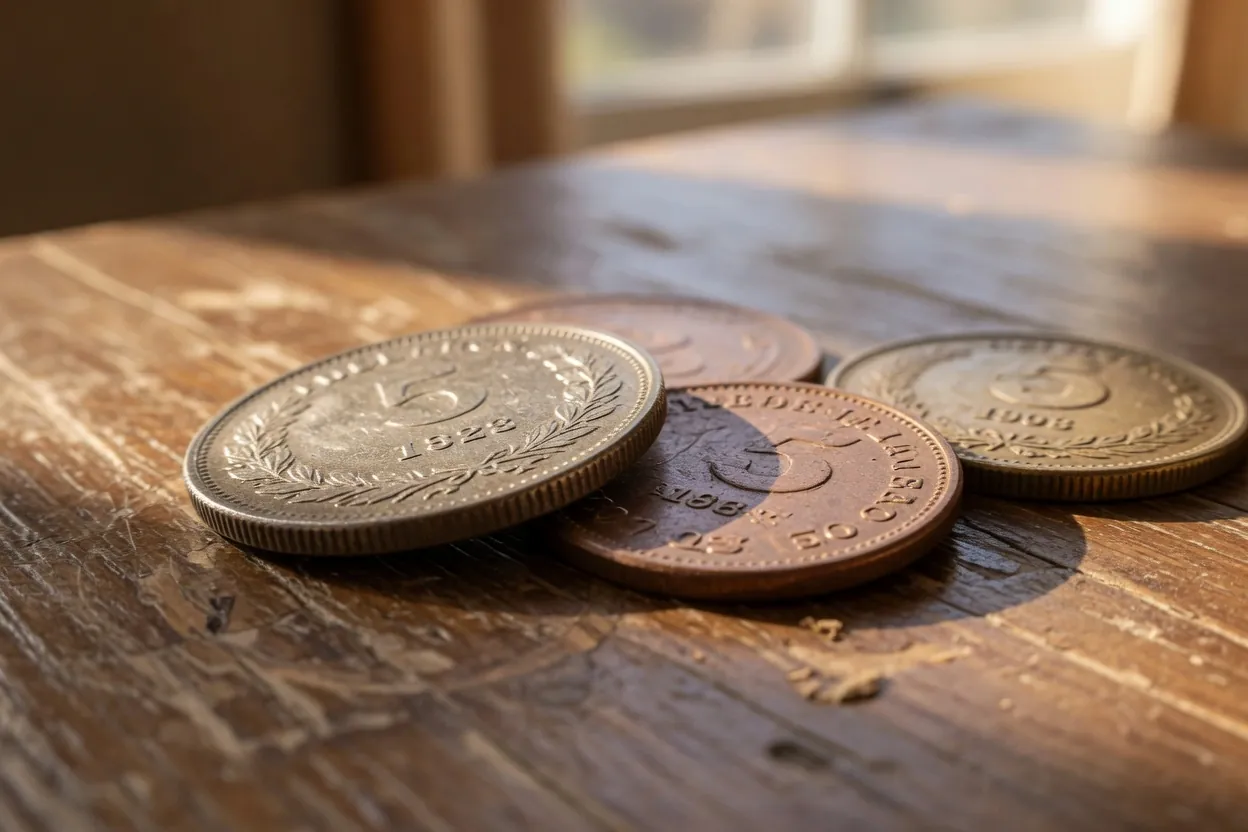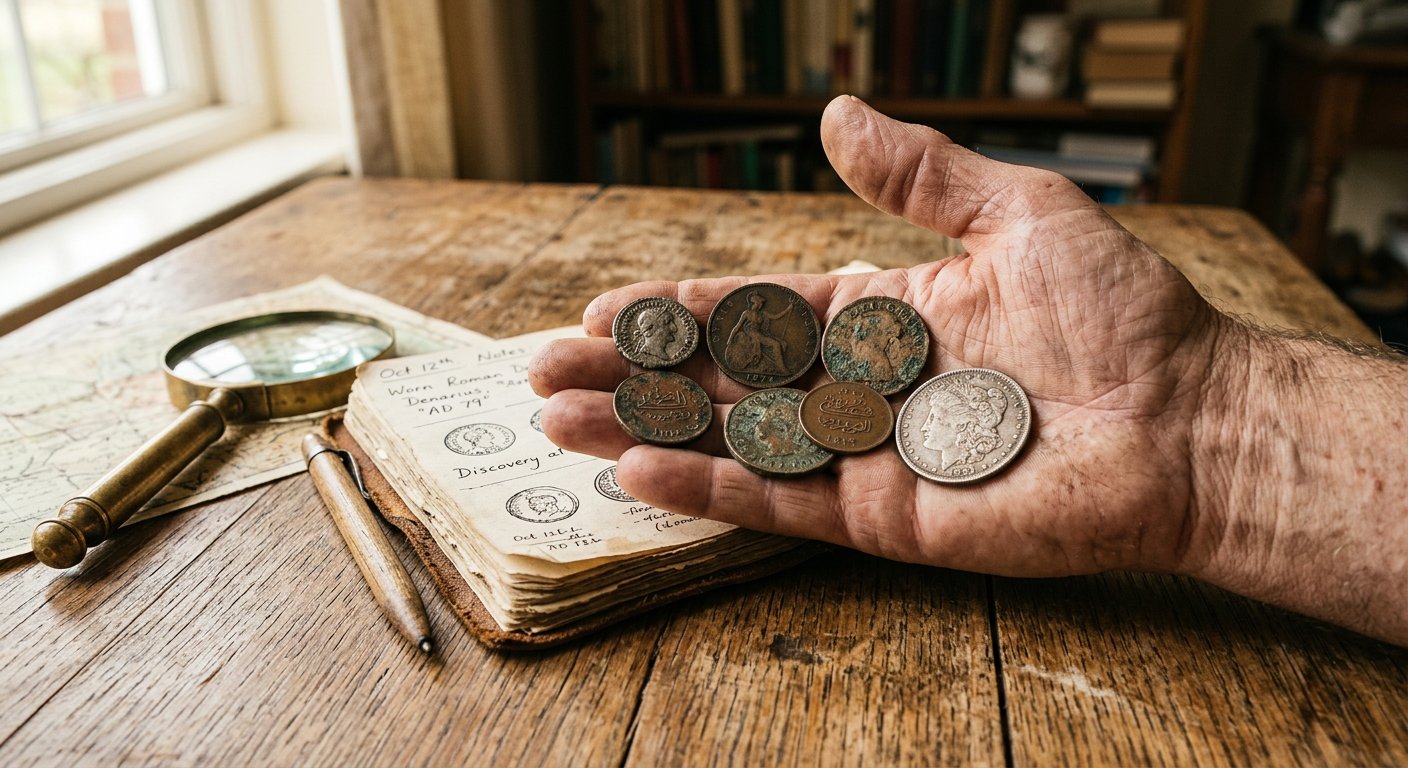
Found an old or foreign coin and want to know what it's worth before spending money on a professional opinion? You're in the right place. This step-by-step guide teaches you how to read the five key features of any coin, recognize the most commonly overlooked valuable pieces, understand basic grading in plain English, and use free AI tools to get a fast, reliable first answer — all without setting foot in a dealer's shop.
Knowing what you have before you talk to anyone is simply smart. It protects you from underselling a valuable find and saves you the cost of professional grading on coins that turn out to be worth face value.
What You'll Need
- The coin(s) in question
- A ruler or calipers (millimeters preferred)
- A kitchen or postal scale accurate to 0.1 grams
- A 5x–10x magnifying glass or jeweler's loupe
- Good lighting (natural daylight or a bright lamp)
- A smartphone with a camera
- Internet access
Estimated Time: 15–45 minutes per coin, depending on complexity
Difficulty Level: Beginner — no prior collecting experience required
Step 1: Read Every Inscription and Date on the Coin
The single most useful thing on any coin is the text. Start here before anything else.
Look for the country of origin, the denomination, and the date. On U.S. coins, the country name ("United States of America") and the denomination ("One Cent," "Quarter Dollar") appear on one side; the date and mint mark appear on the other. Foreign coins follow similar conventions, though the language varies. A coin reading "République Française" is French; "Bundesrepublik Deutschland" is German; "中华人民共和国" is Chinese.
The mint mark is a small letter identifying which facility struck the coin. On U.S. coins, look for a tiny "D" (Denver), "S" (San Francisco), "P" (Philadelphia), or "W" (West Point), usually near the date or on the reverse. Certain mint marks dramatically affect value — a 1909-S VDB Lincoln cent can be worth hundreds of dollars in worn condition, while the same coin from Philadelphia is worth a few dollars. Write down every letter and number you can find before moving on.
Step 2: Study the Imagery — Portraits, Symbols, and Reverse Designs
Once you have the text, examine the images. Coin imagery is one of the fastest ways to narrow down a coin's origin and era when inscriptions are worn or in an unfamiliar language.
Portrait coins — those showing a monarch, president, or historical figure — often have the person's name inscribed around the edge of the portrait. British coins show the reigning monarch; older examples feature Queen Victoria, King George V, or Edward VII. U.S. coins are constitutionally prohibited from depicting living people, so any American coin with a real person's face is a historical figure: Lincoln (penny), Jefferson (nickel), Roosevelt (dime), Washington (quarter), Kennedy (half dollar), or Eisenhower (dollar).
The reverse is equally informative. An eagle is standard on most U.S. coins. A buffalo standing on a mound means you have a Buffalo nickel (1913–1938). Wheat stalks flanking the word "ONE CENT" identify a Wheat penny (1909–1958). A seated figure, a walking figure, or a standing Liberty design narrows the era further. If you can describe the imagery, you can usually find the coin with a basic internet search or an AI identifier.
Step 3: Examine the Edge Type
Most people ignore the edge of a coin entirely. That's a mistake — edge type is one of the fastest authentication and identification clues available.
Three main types:
- Reeded (serrated): Raised parallel ridges running around the circumference. Standard on U.S. dimes, quarters, half dollars, and dollars. Originally added to prevent edge-shaving of silver coins.
- Smooth (plain): No ridges. Common on pennies, nickels, and many foreign coins.
- Lettered: Text or a repeating pattern engraved into the edge. Found on some large-denomination coins, many British coins, and certain commemoratives. The U.S. Presidential dollar series (2007–2016) carries lettered edges with the date, mint mark, and motto.
A coin that should have a reeded edge but has a smooth one — or vice versa — may be a counterfeit, a novelty piece, or a genuine mint error. Hold the coin at eye level and rotate it slowly under good light to inspect the full circumference.
Step 4: Measure Size and Weight
Dimensions and weight are the objective, non-negotiable facts about a coin. They cut through guesswork and help confirm or rule out specific identifications.
Use a millimeter ruler or calipers to measure the diameter, then place the coin on your kitchen scale. Standard specs for common U.S. coins:
| Coin | Diameter | Weight |
|---|---|---|
| Lincoln cent (post-1982) | 19.05 mm | 2.5 g |
| Lincoln cent (pre-1982) | 19.05 mm | 3.11 g |
| Jefferson nickel | 21.21 mm | 5.0 g |
| Roosevelt dime | 17.91 mm | 2.268 g |
| Washington quarter | 24.26 mm | 5.67 g |
| Kennedy half dollar | 30.61 mm | 11.34 g |
A quarter weighing 6.25 grams instead of 5.67 grams might be a 40% silver clad issue from 1965–1970. A pre-1965 silver quarter should weigh exactly 6.25 grams. A cent that weighs 3.11 grams when it should weigh 2.5 grams could be a pre-1982 copper cent — or, in the rarest case, a 1943 copper penny struck in error on a bronze planchet. Weight discrepancies are one of the first things professional graders check, and you can run the same check at home in thirty seconds.
Step 5: Assess Condition Using Basic Grading Terms
Coin grading uses the 70-point Sheldon scale, but you don't need to memorize all 70 grades. Five practical categories determine whether a coin has collector value or is worth face value only.
Poor / Fair (P-1 to F-2): The design is worn almost completely flat. You can make out the basic shape and perhaps the date, but most detail is gone. These coins are generally worth face value unless the date is extremely rare.
Good / Very Good (G-4 to VG-10): Major design elements are visible but heavily worn. The portrait outline is clear; lettering is readable; the date is visible. Common coins in this range carry a modest premium over face value.
Fine / Very Fine (F-12 to VF-35): Moderate to light wear on the high points. Hair strands, feathers, or other fine details are partially visible. Most coins in this range have clear collector appeal.
Extremely Fine / About Uncirculated (EF-40 to AU-58): Light wear only on the very highest points. Original mint luster may still be partially present. Coins in this range carry significant premiums.
Mint State / Uncirculated (MS-60 to MS-70): No wear at all. The coin looks as it did when it left the mint. Even minor contact marks or bag marks affect the grade within this range. A true MS-65 or higher can be worth multiples of an MS-60 example.
A practical test: run your finger across the portrait. If the high points feel smooth and flat, the coin is worn. If the design feels crisp and three-dimensional, it has retained detail and may be worth professional grading.
Step 6: Know the Coins People Find Without Realizing Their Value
Most people sort through a jar of old coins and see pennies, nickels, and dimes. A few of those coins may be worth significantly more than face value. The ones most commonly overlooked:
1943 Copper Penny During World War II, the U.S. Mint switched to zinc-coated steel cents to conserve copper. A small number of copper planchets from 1942 were accidentally left in the presses and struck as 1943 cents. These bronze 1943 pennies are among the most valuable U.S. error coins in existence — genuine examples have sold for over $100,000. The quick test: hold a magnet near the coin. A steel 1943 cent will stick; a copper one will not. If your 1943 penny doesn't attract a magnet, get it authenticated immediately. Note that many copper-plated steel cents circulate as fakes.
Pre-1965 Silver Quarters, Dimes, and Half Dollars Any U.S. dime, quarter, or half dollar dated 1964 or earlier is 90% silver. At current silver prices, a single pre-1965 quarter contains roughly $4–5 worth of silver regardless of its numismatic value. Half dollars from 1965–1970 are 40% silver. Sort by date first — anything before 1965 deserves a second look.
Wheat Pennies (1909–1958) Lincoln cents with wheat stalks on the reverse are common but not worthless. Most are worth 3–10 cents in worn condition. Key dates like the 1909-S VDB, 1914-D, and 1931-S are worth hundreds to thousands of dollars. Even a complete circulated set has collector value.
Buffalo Nickels (1913–1938) The Buffalo nickel features a Native American portrait on the obverse and an American bison on the reverse. Common dates in worn condition sell for $1–5. The 1913-S Type 2, 1916 Doubled Die, and 1937-D "Three-Legged" buffalo are rare varieties worth significant money. The date on Buffalo nickels wears off quickly — a coin with a readable date is worth more than one without.
Foreign Gold Coins Estate cleanouts frequently turn up British sovereigns, French 20-franc Napoleons, Mexican 50-peso "Centenario" coins, and U.S. $20 Saint-Gaudens double eagles. These coins contain substantial gold content regardless of their numismatic premium. A British sovereign contains 0.2354 troy ounces of gold; at current prices, that's over $600 in melt value alone. If you find a gold-colored foreign coin, weigh it and check its diameter before assuming it's a novelty piece.
Step 7: Use an AI Coin Identifier as Your Fast First Step
Before you drive to a dealer or pay a grading fee, use an AI coin identifier to get an instant baseline answer. Snap a clear photo of the obverse (front) and reverse (back) in good light, upload it, and the tool will return an identification, estimated grade range, and approximate value within seconds.
The EasyAI Coin Identifier is a practical starting point. It handles U.S. and foreign coins, reads inscriptions and imagery from your photo, and gives you enough information to decide whether the coin warrants further action. For a broader valuation check, the EasyAI What's It Worth tool can help you contextualize the coin's value alongside other items you may have found — useful when sorting through an estate or yard sale haul.
AI identification is a fast, free first step, not a replacement for professional appraisal on potentially valuable coins. It tells you which coins to take seriously and which ones you can set aside. If you're pricing other items from a sale or cleanout at the same time, the EasyAI Yard Sale Pricer covers a broader range of collectibles.
Step 8: Decide When Professional Grading Is Worth the Cost
Professional grading makes financial sense only when the potential value of the coin exceeds the cost of certification.
PCGS (Professional Coin Grading Service) and NGC (Numismatic Guaranty Company) are the two major grading services in the United States. Both encapsulate coins in tamper-evident plastic holders ("slabs") with an assigned grade and a certification number. A PCGS or NGC grade is recognized by dealers and auction houses worldwide and typically increases a coin's liquidity and sale price.
Current submission fees start around $30–$50 per coin for standard service, with higher tiers for faster turnaround. Add shipping, insurance, and your time, and you're looking at a minimum of $50–$75 per coin for a professional opinion.
Submit for grading if:
- Your research suggests the coin could be worth $200 or more in its current condition
- The coin appears to be a key date, a rare mint mark variety, or a genuine mint error
- You intend to sell and want maximum buyer confidence
- The coin is gold or contains significant silver content above face value
Don't submit for grading if:
- The coin is a common date in worn condition worth less than $20
- The coin shows obvious cleaning (bright, unnatural luster; hairline scratches visible under magnification) — cleaned coins are significantly discounted by graders
- It's a foreign coin with no clear rarity — check the melt value first
One important point from Atlanta Gold and Coin: never clean a coin before submitting it. Cleaning destroys the surface and dramatically reduces the grade. A coin with original patina is almost always worth more than one that has been polished.
Common Issues and Troubleshooting
The date is worn off and I can't read it. Buffalo nickels are notorious for this. Try holding the coin at a sharp angle under a raking light — a flashlight works well. If the date is still unreadable, a product called "Nic-A-Date" (a mild acid solution sold at coin shops) can sometimes reveal worn Buffalo nickel dates. Use it only as a last resort; it slightly alters the coin's surface.
The coin looks gold but I'm not sure if it's real gold. Weigh it and measure its diameter, then compare those figures to known specifications for the coin you think it might be. Real gold coins have very specific weights — a British sovereign weighs 7.99 grams; a U.S. $20 Saint-Gaudens weighs 33.44 grams. A significant deviation suggests a base-metal copy. A jeweler can perform a quick acid test for a few dollars if you're still uncertain.
The AI identifier gave me a result but I'm not confident in it. Cross-reference against the PCGS CoinFacts database or the NGC Coin Explorer, both free online. Enter the date, denomination, and mint mark to pull up population data, auction records, and high-resolution comparison images.
I think I have a doubled die or other mint error. Compare the coin to a normal example of the same date under magnification. Genuine doubled die errors show a distinct mechanical doubling of design elements — letters, numbers, or design features appear to have a second, offset impression. Post-mint damage (scratches, gouges, corrosion) looks irregular and uneven. For a detailed breakdown of how to distinguish genuine errors from damage, American Rarities provides an excellent visual guide.
What's Next
Once you've identified your coins and have a rough sense of their value:
- Separate coins by category: Set aside anything pre-1965 (potential silver), anything that matched a key date or variety in your research, and anything the AI flagged as potentially valuable.
- Check current melt values: For silver and gold coins, use a live spot price calculator to determine the minimum value based on metal content alone. This is your floor — no reputable dealer should offer you less.
- Get a second opinion on high-value candidates: Take coins that appear to be worth $100 or more to at least two local dealers for competing offers. You are not obligated to sell.
- Submit to PCGS or NGC if the numbers work: Use the grading fee calculator on each service's website to confirm that certification makes financial sense before you commit.
- Store coins properly while you decide: Place coins in individual 2x2 cardboard flips or soft polyethylene coin flips. Never use PVC-based holders, which leach a damaging gas that creates green slime on coin surfaces over time.
The Enoch Pratt Free Library's coin evaluation guide also notes that public libraries often carry the "Red Book" (A Guide Book of United States Coins) and the Standard Catalog of World Coins — free references you can consult in person before making any decisions.
Frequently Asked Questions
How do I identify a coin when the date is completely worn off?
Look at the design style, size, weight, and edge type to narrow down the era and denomination. For U.S. coins, the portrait and reverse design changed at specific dates, which helps bracket the time period. An AI coin identifier can often make an identification from imagery alone even without a visible date.
Is it worth taking old coins to a dealer if I don't know what I have?
It can be, but go in informed. Use the steps in this guide and an AI identifier first so you have a baseline understanding of what you're bringing. Dealers are more likely to make fair offers when they know you've done your homework, and you'll be better positioned to recognize an unreasonably low bid.
What's the difference between PCGS and NGC grading?
Both are widely respected, and coins graded by either service command similar market premiums. PCGS has historically been considered slightly more conservative in its grading, while NGC grades a broader range of world and ancient coins. For most U.S. coins, either service is acceptable; check which buyers in your target market prefer before submitting.
Can I clean a coin to make it look better before identifying or selling it?
No. Cleaning a coin — even with mild soap and water — removes the natural patina that forms on the surface over decades. Professional graders immediately recognize cleaned coins and assign them a "details" grade that carries a significant discount. Leave coins exactly as you found them.
How accurate are AI coin identifiers?
Generally reliable for common U.S. and major world coins, and improving continuously as training data expands. Less reliable for obscure foreign issues, heavily worn coins with illegible text, and rare varieties that require expert examination. Treat AI results as a strong starting point for research, not a final appraisal.
What is the fastest way to check if a coin contains silver?
Check the date first. Any U.S. dime, quarter, or half dollar dated 1964 or earlier is 90% silver. Half dollars from 1965–1970 are 40% silver. You can also look at the edge: silver coins show a solid silver-white edge, while clad coins show a visible copper-colored stripe between two silver-colored layers.